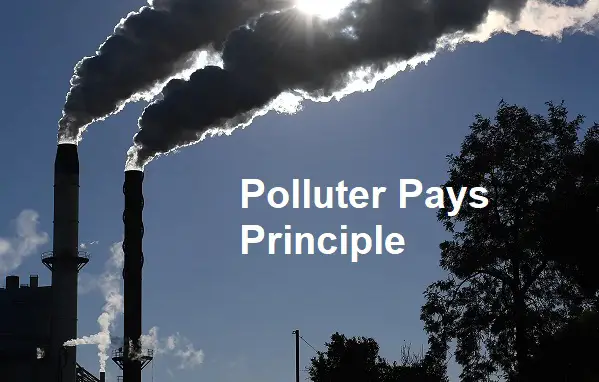
The Polluter Pays Principle is a generally accepted practice in which polluters must bear the costs of managing the pollution they create to prevent harm to human health or the environment. For example, manufacturers who produce potentially toxic substances as by-products of their activities must be responsible for handling them safely. The Polluter Pays Principle is part of a broader set of principles guiding sustainable development around the world (formally known as the 1992 Rio Declaration). These principles form the basis for most pollution regulations affecting land, water and air.
Evolutionary History of the Creation of the Polluter Pays Principle (PPP)
From a legal perspective, there is precedent referring to the state’s obligation to guarantee and compensate polluters. This occurred in the 1938-1941 smelting arbitration case between Canada and the United States, in which a court ordered Canada and the United States to reduce and prevent damage from air pollution in Washington State.
As Europe seeks to incorporate common solutions to reduce environmental pollution, the Polluter Pays Principle (PPP) appeared in the 1968 “Declaration of Principles” on Air Pollution Control adopted by the Committee of Ministers of the Council of Europe.
The PPP principle states: The costs incurred to prevent or reduce pollution must be borne by the party that caused it. This is no exception from public authorities. Later, in response to similar concerns about the environment, it was included in an OECD instrument but was non-binding. The 1972 OECD Recommendation Concerning Guiding Principles on International Economic Aspects of Environmental Policy, which is recognized as the first international document governing public-private partnerships. The recommendation establishes the following principles:
The principle of allocating the costs of pollution prevention and control measures to promote the rational use of scarce environmental resources and avoid distortions in international trade and investment. This principle implies that polluters should bear the cost of implementing the above-mentioned measures decided by public authorities to ensure that the environment is in an acceptable state. In other words, the costs of these actions must be reflected in the costs of producing and/or consuming polluting goods and services.
The European Community (now the European Union) also articulated the adoption of progressive PPPs, including the Program for Action on the Environment (1973), Recommendations on Cost Allocations and Actions of Public Authorities on Environmental Matters and in 1986 adopted The Single European Act. Finally, PPPs serve as the core principles and strict legal standards of the European legal system that guide and implement EU environmental policies. Although the principle is not widely used outside the European Union and the United States, other countries such as Australia, Ghana and Zimbabwe have incorporated the principle into policies and regulations.
The regulations follow the lines of international cooperation on responsibility and compensation for the effects of pollution that emerged during the 1972 United Nations Conference on the Human Environment and incorporate Principle 22 of the Stockholm Declaration. 20 years later, PPP was widely incorporated into Principle 16 of the Rio Declaration on Environment and Development adopted by the United Nations Conference on Environment and Development (Earth Summit).
Can the Polluter Pays Principle work?
Regardless of the type of instrument used, many economists agree that the amount of carbon must be uniform globally, and across countries and sectors, so that polluters do not simply shift operations to so-called “pollution havens”. The High Commission on Carbon Pricing report (2017) estimates that the appropriate global carbon amount should be US$ 40-80/tCO 2 e in 2020 and US$ 50-100/tCO 2 e in 2030. For jurisdictions using carbon taxes , this requires a direct rate at the corresponding carbon price. However, carbon taxes are often difficult to implement politically. For jurisdictions with emissions trading systems, stricter restrictions could be imposed to limit supply clearances thereby indirectly driving up carbon prices to Paris Agreement-compliant levels.
Environmental issues have indeed become an issue that is considered seriously in the last few decades. As far as I know, the world’s concern about the greenhouse effect has occurred since the decade of the 80s. But the discussion of environmental issues, especially global warming, has only emerged seriously in the last 10 years. Many things were discussed and agreed upon, especially regarding global warming, and the concept of the polluter pays principle is one of the results.
The Polluter Pays Principle is a concept in which countries or parties that produce pollution must pay compensation for the pollution they produce. The compensation fund will ideally be projected for various environmental preservation efforts. Logically, the party causing the damage (pollution) must compensate for the damage. Indeed, in principle, the pollution created will burden the environment and cannot be valued in money. But pollution will continue because of human need for industry, and at least with that money the impact of environmental damage can be minimized. So, the aspiration to create sustainable and sustainable environmental conditions can go hand in hand with industrial interests, more or less that’s the basic idea.
In this polluter pays principle concept, there are two payment mechanisms that can be made. First, based on the amount of waste or pollution produced. In this method, the amount of money that must be paid by the polluter is dependent on the volume of waste/pollution produced, the more pollution, the more expensive the fees to be paid. The second concept is with a quota system, so each party, for example a state or a company, has a quota limit for producing pollutants. If the quota is exceeded, pollutant producers must pay a fine as compensation.
The money obtained from these polluters will be used to finance environmental preservation. For example, for planting trees, reforestation, or making pollution treatment facilities. The recipient of this money is the government or the aggrieved party. Internationally, it is reported that there will be quotas for each country in producing pollutants. If the quota is exceeded, polluting countries must pay this compensation money to countries with minimal pollution so that the world’s balance in environmental matters will be maintained.